Support our educational content for free when you purchase through links on our site. Learn more
15 Green Technologies That Help You Protect the Planet 🌱

How can individuals make a positive impact on the environment by adopting green technologies? Start by cutting the energy and resources you waste, then choose proven options—like efficient appliances, heat pumps, renewable electricity, and lower-emission transportation—that fit your home and daily life.
We’ve learned that the smartest upgrade isn’t always the flashiest one. A drafty window, an unnoticed leak, or a short drive you could swap for a walk may offer a better first step than another gadget with a shiny app.
The trick is to look past the “green” label: what does the technology replace, how long will it last, and what happens when it’s no longer useful? That’s how small choices become meaningful, measurable progress.
Key Takeaways
- Start with the biggest source of waste in your home, commute, or workplace; measure before and after when you can.
- Prioritize efficiency first: insulation, LEDs, efficient appliances, and water-saving fixtures can reduce demand.
- Choose technologies that fit local conditions. Solar, heat pumps, and electric vehicles have different benefits depending on your building, climate, electricity, and travel needs.
- Look beyond marketing claims: consider durability, repairability, lifecycle impacts, and responsible recycling.
- Pair technology with everyday conservation—using less and wasting less strengthens the benefits.
- Share what works and advocate for broader change: community programs, trusted information, and transparent policies help good ideas spread.
Table of Contents
- ⚡️ Quick Tips and Facts
- 🌱 What Green Technology Means for the Environment
- Green technology, clean technology, and sustainability: what’s the difference?
- How everyday choices add up to environmental impact
- 📜 How Green Technologies Have Evolved
- 🔍 How to Choose Green Technologies That Make a Real Difference
- Look beyond labels: lifecycle emissions and total environmental footprint
- Check efficiency, durability, repairability, and recyclability
- Balance cost, access, and potential environmental trade-offs
- 🏡 15 Practical Ways to Make a Positive Environmental Impact with Green Technology
- 1. Switch to renewable electricity
- 2. Install rooftop solar or community solar
- 3. Add battery storage and use energy wisely
- 4. Upgrade to efficient heating and cooling
- 5. Improve insulation and install smart thermostats
- 6. Choose energy-efficient appliances and lighting
- 7. Drive electric or choose lower-carbon transportation
- 8. Make walking, cycling, and public transit easier
- 9. Reduce food waste with smart storage and composting
- 10. Use water-saving fixtures and leak-detection technology
- 11. Adopt efficient cooking and food-growing tools
- 12. Buy durable, repairable electronics and use them longer
- 13. Reuse, recycle, and choose low-waste technologies
- 14. Monitor your household energy and carbon footprint
- 15. Support green technology at work and in your community
- 🔋 Green Technology Options by Home, Transport, and Lifestyle
- At home: energy, water, waste, and indoor comfort
- On the road: electric vehicles, charging, and shared mobility
- At work and school: efficient buildings and cleaner operations
- 📊 Comparing Green Technologies: Benefits, Limits, and Best Uses
- 🧮 How to Measure Your Environmental Impact
- Track energy use, emissions, water, and waste
- Estimate savings without double-counting benefits
- Set realistic goals and review your progress
- 💸 Costs, Incentives, and Making Green Technology More Accessible
- Financing, rebates, tax credits, and utility programs
- Lower-cost options for renters and households on a budget
- Community ownership and shared clean-energy solutions
- ⚠️ Common Green Technology Pitfalls and How to Avoid Them
- Greenwashing, misleading claims, and weak certifications
- Rebound effects, e-waste, and hidden supply-chain impacts
- Why technology works best alongside everyday conservation
- 🤝 How Individuals Can Encourage Wider Green Technology Adoption
- Talk with neighbors, employers, and local leaders
- Advocate for clean-energy policies and resilient infrastructure
- Choose responsible companies and share reliable information
- ❓ Frequently Asked Questions
- Which green technology has the biggest environmental benefit?
- What is the easiest green technology to adopt first?
- Can renters make a meaningful environmental impact?
- Are electric vehicles and solar panels always greener?
- How can I tell whether a product is genuinely sustainable?
- ✅ Conclusion
- 🔗 Recommended Links
- 📚 Reference Links
⚡️ Quick Tips and Facts
The first practical move usually isn’t buying a shiny new gadget. It’s finding where your home, commute, or workplace wastes the most energy, then choosing a proven fix. Our broader guide to green technologies looks at how these tools fit into everyday life.
| Quick action | Why it can help | A good first step |
|---|---|---|
| Choose cleaner electricity | Electricity generation is a major source of energy-related emissions; the International Energy Agency tracks how the power mix affects emissions. | Ask your utility about renewable-energy plans or community solar. |
| Cut wasted heating and cooling | Buildings account for a substantial share of energy use and emissions; UNEP’s Global Status Report for Buildings and Construction explains why efficiency matters. | Seal drafts, check insulation, and adjust thermostat schedules. |
| Replace inefficient equipment strategically | Efficient appliances and heat pumps can reduce energy use while maintaining comfort. | Compare ENERGY STAR certified models when equipment needs replacing. |
| Make shorter car trips cleaner | Walking, cycling, public transit, and electric vehicles can reduce reliance on gasoline-powered travel. | Combine errands or replace one short drive each week. |
| Reduce food and water waste | Smart storage, leak detection, and efficient fixtures can help conserve resources. | Fix leaks first; they waste water without doing anything useful. |
| Buy less, keep products longer | Manufacturing and disposal also have environmental footprints. | Repair, reuse, and recycle electronics through responsible programs. |
A useful rule of thumb: Prioritize measures that fit your local climate, electricity mix, building, and travel needs. A technology’s label is not proof that it will deliver the same benefit everywhere.
🌱 What Green Technology Means for the Environment
Green technology is a broad term for products, systems, and practices designed to reduce environmental harm or use resources more efficiently. That can mean a solar panel on a roof, a heat pump replacing a fossil-fuel furnace, a low-flow showerhead, or GPS-guided irrigation on a farm.
The environmental payoff depends on what a technology replaces, how it is made, how it is powered, and how long it lasts. An efficient appliance running on a carbon-intensive grid may still use less electricity than an inefficient one, but its emissions benefit can differ from the same appliance on a cleaner grid. The U.S. Environmental Protection Agency’s lifecycle assessment resources explain why it helps to look beyond a product’s use phase.
Green technology, clean technology, and sustainability: what’s the difference?
These terms overlap, but they are not identical:
- Green technology generally refers tools and systems intended to reduce environmental impacts.
- Clean technology often emphasizes lower pollution and more efficient use of resources.
- Sustainability is broader: it considers environmental, social, and economic outcomes over time.
A product can be efficient in one respect and still have trade-offs elsewhere. For example, a battery-powered tool may avoid tailpipe emissions during use, but its materials, manufacturing, electricity source, and end-of-life handling still matter.
How everyday choices add up to environmental impact
Individual choices matter most when they support durable changes and help shift wider systems. Choosing efficient equipment can reduce household demand; buying from companies with verifiable environmental progress can support innovation; and sharing trustworthy information can help good practices spread.
Our carbon footprint reduction and conservation tips categories offer practical ways to connect personal habits with bigger resource savings.
Agriculture belongs in this conversation, too. Green technologies can include integrated pest management, improved irrigation, and precision tools that help farmers target inputs. A study of 303 grain farmers in China found that green values were associated with both innovative intentions and technology adoption. That is evidence about farmer behavior in a particular sample—not proof that every technology works equally well everywhere. Read the study on farmers’ green values and technology adoption for its findings and limitations.
📜 How Green Technologies Have Evolved
Green technology is not a single recent invention. It includes long-standing practices, such as conserving water and repairing useful goods, alongside modern tools such as grid-scale batteries, electric vehicles, efficient heat pumps, and satellite-supported farm management.
The big shift is that many technologies now connect: a well-insulated home needs less heating; a heat pump supplies that heat efficiently; smart controls help operate it when useful; and cleaner electricity can reduce the emissions associated with running it. The U.S. Department of Energy’s home energy resources explain how these measures work together.
Agriculture offers another example. Farmers may combine ecological pest controls, physical methods, targeted pesticide use, and better field data rather than depending one tool alone. Research on 754 vegetable farmers in Shandong, China, found that social norms, networks, and trust were associated with adoption of green control technologies. The authors describe social connections as a route for “information dissemination, risk sharing, demonstration, and guidance.” The results concern adoption behavior in the study sample; they should not be mistaken for a guarantee of specific environmental outcomes. See the research on social capital and green control technology adoption.
For a wide-ranging background reference, Dustin Mulvaney’s book Green Technology: An A-to-Z Guide covers topics from renewable energy and electric vehicles to clean water, sustainable agriculture, and waste management. It’s a handy reminder that environmental progress is a toolbox, not a single magic switch.
🔍 How to Choose Green Technologies That Make a Real Difference
Before choosing a product, ask what problem it solves. Then check whether it solves that problem effectively, safely, and for long enough to justify the resources used to make it.
Look beyond labels: lifecycle emissions and total environmental footprint
A product’s environmental footprint can include:
- Raw-material extraction and manufacturing
- Transport and packaging
- Energy and water used during operation
- Maintenance and replacement parts
- Disposal, recycling, or reuse
Lifecycle assessment helps compare these stages. The EPA’s lifecycle assessment overview is a useful starting point. For appliances, look for credible certifications such as ENERGY STAR, but remember that a certification is a screening tool—not a promise of identical savings in every home.
Check efficiency, durability, repairability, and recyclability
A worthwhile technology should ideally be:
- Efficient: It delivers the needed service with less energy or water.
- Durable: It is likely to last rather than require frequent replacement.
- Repairable: Parts, repair information, and qualified service are available.
- Appropriate: Its capacity suits your household or workplace.
- Responsibly managed at end of life: Batteries, electronics, and other materials can be collected and handled properly.
For electronics, the EPA’s electronics donation and recycling guidance explains how to find responsible pathways. Keeping a working device longer is often a smarter environmental move than replacing it solely for a newer feature.
Balance cost, access, and potential environmental trade-offs
Up-front cost, rental rules, building type, climate, and access to installers can all affect what is realistic. A homeowner may be able to install rooftop solar, while a renter may get more benefit from draft sealing, efficient lighting, or a community-solar subscription.
No option is perfect for everyone. Consider the local electricity mix before estimating the benefit of electrifying heating or transport, and check whether a technology can be repaired or recycled in your area. For a consumer’s perspective on sustainability claims, our eco-conscious brands coverage can help you assess what companies say against what they disclose.
🏡 15 Practical Ways to Make a Positive Environmental Impact with Green Technology
Start with the option that addresses your biggest practical source of waste. There is no prize for installing five smart gadgets while a leaky window lets your heating bill—and your heat—escape.
1. Switch to renewable electricity
If your utility offers a renewable electricity plan or green tariff, compare how it works and what its environmental claims mean. In some areas, community solar offers another way to support or access solar generation without installing panels at home.
Steps:
- Find your utility’s official clean-energy options.
- Check whether the plan adds renewable generation or uses renewable energy certificates.
- Review contract terms, eligibility, and cancellation rules.
- Compare the claim with your utility’s published information and local regulations.
The U.S. Department of Energy’s community solar guidance outlines how shared solar programs work. Availability and program structure vary by location.
2. Install rooftop solar or community solar
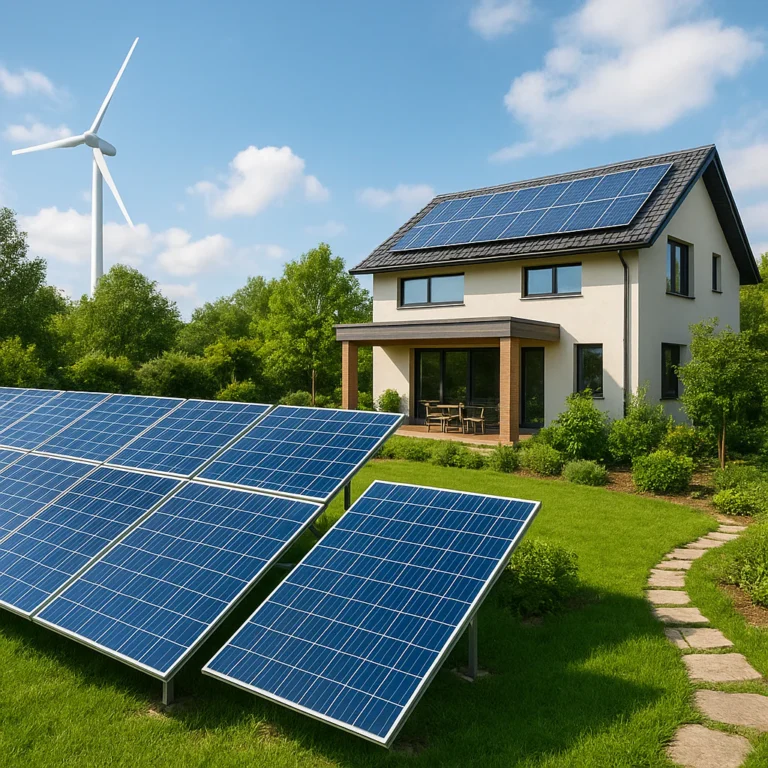
Rooftop solar can generate electricity at the home, while community solar allows multiple participants to benefit from a shared project. Whether rooftop panels suit you depends on roof condition, shade, orientation, local rules, and your electricity use.
Before signing a contract:
- Get more than one site assessment.
- Ask about equipment warranties, installer licensing, maintenance, and system monitoring.
- Confirm how the system connects to the grid and how excess generation is credited.
- Check roof age; it can be sensible to repair or replace a roof before panels go on.
- Review the agreement carefully, especially if the system is leased or financed.
The U.S. Department of Energy’s homeowner solar guide covers key questions. Solar panels are not automatically a good fit for every roof, but a credible assessment can tell you much more than a sunny sales pitch.
3. Add battery storage and use energy wisely
Home batteries can store electricity for later use, provide backup during some outages, or help households use more of their own solar generation. Their value depends on local utility rules, outage needs, grid conditions, and battery chemistry.
A battery is not a substitute for reducing unnecessary demand. Begin by checking which appliances use the most energy and whether shifting flexible tasks—such as laundry—can help. The DOE’s guide to home battery storage provides background on energy storage technologies.
4. Upgrade to efficient heating and cooling
Heat pumps move heat rather than generating it through combustion or electric resistance. Depending on the home, climate, and electricity source, they can provide efficient heating and cooling. Proper sizing and installation matter: the most impressive equipment spec cannot rescue a poor installation.
Consider an assessment from a qualified contractor and check the ENERGY STAR heat pump guidance before replacing a system.
Also consider indoor comfort: Correct ventilation, filtration, and maintenance affect indoor conditions. Avoid blocking vents, and follow manufacturer instructions for changing filters.
5. Improve insulation and install smart thermostats
Insulation and air sealing reduce unwanted heat transfer. A programmable or smart thermostat can help manage heating and cooling schedules, but it cannot fix a drafty building on its own.
A sensible sequence:
- Find drafts around doors, windows, and service openings.
- Check attic, wall, and floor insulation where accessible.
- Address moisture or ventilation issues before sealing spaces.
- Choose thermostat settings that match how the household actually uses the home.
- Monitor energy use and comfort after changes.
The DOE’s insulation and air sealing guidance explains common improvements. For smart controls, look for a device that works with your heating system, and review what data it collects.
6. Choose energy-efficient appliances and lighting
When an appliance is due for replacement, compare its energy use—not just its appearance or feature list. ENERGY STAR provides product specifications and guidance for many household categories.
LED lighting uses less electricity than traditional incandescent lighting and generally lasts longer. The U.S. Department of Energy’s LED lighting guide explains the basics.
Our practical advice: Don’t replace a functioning appliance just because a newer model exists. Compare the likely savings, repair options, and remaining life of the existing unit.
7. Drive electric or choose lower-carbon transportation
Electric vehicles have no tailpipe emissions while driving, which can reduce street-level exhaust where they are used. Their total lifecycle emissions depend on vehicle manufacturing, battery production, and the electricity used for charging. The U.S. EPA’s electric vehicle resource addresses common questions and comparisons.
If you are considering an EV, check:
- Daily driving distance and charging access
- Whether home or workplace charging is practical
- The vehicle’s efficiency and battery warranty
- Local public charging availability
- How the electricity mix affects estimated emissions
An EV is not the only lower-carbon option. Keeping a reliable car longer, sharing rides, and making suitable trips by transit, bike, or foot can also reduce driving.
8. Make walking, cycling, and public transit easier
Technology can support low-emission travel without putting a motor in every vehicle. Transit apps, route planners, secure bicycle parking, and e-bikes can make alternatives more convenient.
Try this small experiment: plan one regular trip using a mode other than a car. Choose a route, check schedules or charging needs, and see what makes it easy or difficult. If safe infrastructure is missing, support local planning that makes walking, cycling, and transit more accessible.
9. Reduce food waste with smart storage and composting
Food waste represents wasted land, water, energy, and labor. Smart storage technology can help, but simple habits—labeling leftovers, freezing food before it spoils, and planning meals around what you have—often work beautifully without an app.
The U.S. EPA’s food waste resources explain prevention, donation, and composting options. Composting is useful when a suitable collection system or home setup is available; it is not a reason to generate extra food waste.
10. Use water-saving fixtures and leak-detection technology
Low-flow showerheads, efficient toilets, faucet aerators, irrigation controllers, and leak sensors can reduce water use. Smart devices are most useful when they help you find or prevent a problem—not when they add another dashboard no one checks.
Start here:
- Read your water meter or bill to establish a baseline.
- Check toilets, faucets, outdoor taps, and irrigation for leaks.
- Install compatible water-saving fixtures.
- Use weather-aware irrigation settings where appropriate.
- Recheck usage to see whether the changes worked.
The EPA WaterSense program provides information on water-efficient products and practices.
11. Adopt efficient cooking and food-growing tools
Induction cooktops heat compatible cookware using electromagnetic energy and can be an efficient alternative to conventional electric resistance cooking. They avoid combustion at the cooktop, although the home’s broader energy and ventilation conditions still matter. Check the DOE’s induction cooking overview for how the technology works.
For home growing, timers, moisture sensors, and drip irrigation can help manage water. Outdoors, choose systems that fit the plants, soil, and local rainfall rather than watering by an arbitrary schedule.
12. Buy durable, repairable electronics and use them longer
Phones, laptops, routers, and household electronics carry material and manufacturing impacts. Choosing durable devices, repairing them when practical, and recycling them responsibly can reduce premature disposal.
Before buying:
- Check warranty length and repair support.
- Look for replaceable components where relevant.
- Buy only the capacity and features you will use.
- Keep devices secure and updated for as long as they remain supported.
- Find a responsible reuse or recycling option before disposal.
The EPA’s electronics donation and recycling page explains ways to pass on or recycle electronics.
13. Reuse, recycle, and choose low-waste technologies
Technology can help sort waste, manage recycling, or support reuse platforms, but reducing demand for disposable items usually comes first. Check local recycling rules: “recyclable” does not always mean accepted in your curbside program.
For batteries, lamps, electronics, and other special materials, follow local collection guidance rather than placing them in general recycling. The EPA’s recycling resources explain how to reduce waste and find suitable pathways.
14. Monitor your household energy and carbon footprint
A smart meter, utility portal, or home energy monitor can show when electricity use rises. A carbon-footprint calculator can help identify major categories, but treat results as estimates: data quality and assumptions vary.
Try a simple monthly check:
- Compare electricity and gas use with the same season last year.
- Note changes in household size, weather, or equipment.
- Identify one unusually high-use period.
- Choose one action and check again after a month.
Our climate change and carbon footprint reduction resources can help connect personal tracking to broader climate action.
15. Support green technology at work and in your community
Individual adoption can spread through workplaces, cooperatives, schools, and neighborhoods. Ask your employer about energy audits, clean electricity procurement, efficient equipment, commuter support, and transparent emissions reporting.
In farming communities, peer learning and demonstrations can help people evaluate unfamiliar practices. The Shandong study of vegetable farmers found positive associations between social norms, social networks, trust, and green control technology adoption. Its authors recommend demonstration by experienced local farmers; that approach is promising, but adoption still needs to fit local crops, knowledge, and conditions.
A separate study of 312 senior managers at Chinese listed manufacturing companies found positive relationships between environmental regulation, ESG performance, green innovation, and enterprise resilience. Those results concern organizations in a specific national and industry context—not household technology performance. The takeaway for individuals is narrower but useful: ask companies to show evidence, not just slogans. See the research on ESG, green innovation, and organizational resilience.
🔋 Green Technology Options by Home, Transport, and Lifestyle
| Area | Options to consider | Potential benefits | Check before adopting |
|---|---|---|---|
| Home energy | Insulation, heat pumps, LEDs, efficient appliances, solar | Lower energy demand or cleaner electricity | Building condition, climate, grid, installation quality |
| Transportation | EVs, transit tools, e-bikes, shared mobility | Less fuel use and lower tailpipe pollution | Charging, trip needs, local infrastructure |
| Water | Efficient fixtures, leak sensors, irrigation controls | Lower water use and fewer leaks | Local water availability, device compatibility |
| Food and waste | Smart storage, composting, reuse systems | Less food and material waste | Local collection, practical household habits |
| Agriculture | Precision irrigation, GPS, integrated pest management | More targeted resource use and pollution prevention | Crop, soil, local expertise, cost and evidence |
At home: energy, water, waste, and indoor comfort
The best home improvements usually work as a system. First reduce drafts and unnecessary demand; then choose efficient equipment; then consider renewable electricity or storage if it suits your home.
For indoor comfort, pay attention to ventilation, moisture, and equipment maintenance as well as energy consumption. A very efficient home still needs appropriate fresh air and humidity control.
On the road: electric vehicles, charging, and shared mobility
EVs can reduce local tailpipe pollution, while transit, cycling, walking, and car-sharing can reduce the need for private vehicle trips. Which choice delivers the greatest benefit depends on travel patterns, vehicle occupancy, charging access, and local electricity.
The EPA’s Green Vehicle Guide provides information for comparing vehicle emissions and fuel economy.
At work and school: efficient buildings and cleaner operations
Organizations can reduce energy and resource use through efficient lighting, building controls, clean power, water management, and lower-waste purchasing. Employees and students can help by asking for transparent targets, publishing progress, and measuring actual results.
Look for evidence: energy data, project descriptions, timelines, and accountability are more informative than a vague “eco-friendly” claim.
📊 Comparing Green Technologies: Benefits, Limits, and Best Uses
| Technology | Often most useful when | Main benefit | Important limitation |
|---|---|---|---|
| Solar panels | Roof and local rules support installation | On-site renewable electricity | Roof condition, shading, grid rules, and lifecycle impacts matter |
| Heat pumps | A suitable system can replace less efficient heating or cooling | Efficient space conditioning | Climate, installation, insulation, and electricity mix affect performance |
| Smart thermostats | Schedules and controls can be improved | Can manage heating and cooling more precisely | Savings are not automatic; settings and compatibility matter |
| EVs | Charging is practical and trips fit the vehicle | No tailpipe emissions while driving | Manufacturing and electricity affect lifecycle emissions |
| LED lighting | Traditional bulbs remain in use | Lower electricity use and longer life | Savings depend on the number of bulbs and hours used |
| Water-efficient fixtures | Existing fixtures use more water than needed | Lower water use | Choose certified products suited to local plumbing |
| Farm precision tools | Local data can improve input decisions | Better targeting of water or other inputs | Training, equipment access, and local conditions matter |
These technologies are not rivals. A home may benefit from weatherization before a heat pump; an EV can have a smaller footprint when paired with cleaner electricity; and water sensors are most valuable when someone responds to alerts.
For broad background on energy, transport, buildings, agriculture, and waste, the International Energy Agency, U.S. Department of Energy, and EPA offer reliable technical resources.
🧮 How to Measure Your Environmental Impact
Measurement helps distinguish a useful improvement from a satisfying-looking app notification. Keep the approach simple enough that you’ll use it.
Track energy use, emissions, water, and waste
Start with bills, meter readings, and equipment records. Track one or more useful indicators:
- Electricity and fuel use
- Household water use
- Vehicle miles or fuel consumption
- Food waste and landfill-bound waste
- Equipment use before and after an upgrade
For emissions estimates, use transparent tools and note their assumptions. The EPA’s household carbon footprint calculator can help identify broad categories, but it is an estimate—not a personal emissions audit.
Estimate savings without double-counting benefits
If you install a heat pump, improve insulation, and change thermostat settings at the same time, don’t credit each measure with the full combined reduction. Their effects overlap.
A sensible comparison:
- Record a baseline period.
- Note weather and occupancy changes.
- Compare similar periods where possible.
- Use utility data or equipment measurements.
- Report estimates as estimates, not guaranteed results.
Set realistic goals and review your progress
Choose goals you can measure, such as reducing electricity use from a baseline or making a certain number of weekly trips without a car. Review progress quarterly or seasonally, then adjust.
A missed target is information, not a moral failing. Maybe the equipment was poorly sized, a household schedule changed, or the initial estimate was too optimistic. Fix the assumption and keep the useful habit.
💸 Costs, Incentives, and Making Green Technology More Accessible
The most sustainable choice is not always the most expensive equipment, and not everyone controls their building or vehicle. Start with measures that are feasible in your circumstances, then explore support programs for larger upgrades.
Financing, rebates, tax credits, and utility programs
Incentives vary by location and change over time. Check current information through government and utility sources rather than relying on old blog posts or a salesperson’s summary.
- The DOE’s energy-saving resources explain efficiency improvements.
- The ENERGY STAR rebate finder can identify some local programs.
- Your utility may offer audits, rebates, or efficiency services.
Read the terms closely, confirm eligibility, and include installation, maintenance, and financing in the decision.
Lower-cost options for renters and households on a budget
Useful steps may include LED bulbs, faucet aerators, draft stoppers, power strips, efficient showerheads, and reporting leaks to property management. Ask before making modifications that could affect fixtures, wiring, or lease terms.
For shared or rented housing, community solar, public transit, e-bike libraries, and local repair events may provide access without owning the technology.
Community ownership and shared clean-energy solutions
Community solar, cooperative purchasing, shared EV charging, and neighborhood tool libraries can spread benefits and costs. Programs need clear contracts, fair eligibility, and accessible information.
For agricultural technologies, cooperative learning can help farmers evaluate equipment and practices before committing. Studies of Chinese farmers suggest that trusted social networks and visible peer examples are associated with adoption—but local demonstration should complement, not replace, independent agronomic advice.
⚠️ Common Green Technology Pitfalls and How to Avoid Them
Greenwashing, misleading claims, and weak certifications
Watch for broad claims such as “planet friendly” without supporting evidence. Ask:
- What impact is being reduced?
- Compared with what alternative?
- Over what period and lifecycle stage?
- Is the claim independently verified?
- Does the company publish measurable progress?
A study of Chinese manufacturing firms discusses how greenwashing can mislead consumers and disadvantage companies making genuine improvements. Its authors argue for stronger disclosure and accountability. That is a useful caution, though the study’s corporate findings should not be stretched into a rating of individual consumer products. Read the full research article.
Rebound effects, e-waste, and hidden supply-chain impacts
An efficiency improvement can sometimes encourage more use—for example, driving farther because a vehicle uses less energy per mile. This is called a rebound effect. It does not erase the value of efficiency, but it shows why total use still matters.
Other issues include battery materials, manufacturing emissions, short product lifetimes, and inadequate recycling. The International Energy Agency’s critical minerals work discusses materials needed for clean-energy technologies. Reduce avoidable demand, choose durable products, and use responsible recycling routes.
Why technology works best alongside everyday conservation
Technology can improve how we provide a service; conservation can reduce how much of that service we need. Both matter.
- A heat pump works better in a home that does not leak heat unnecessarily.
- Efficient irrigation helps, but appropriate watering and soil care still matter.
- An EV may reduce travel emissions, but fewer unnecessary trips reduce demand further.
- A recycling system helps, but reusing a working item can avoid more waste.
Our conservation tips are full of low-tech habits that pair well with efficient equipment. No app required. 📵
🤝 How Individuals Can Encourage Wider Green Technology Adoption
Talk with neighbors, employers, and local leaders
Share practical experience, including what did not work. A neighbor’s account of installer quality or a building’s energy audit can be more useful than a glossy advertisement—as long as anecdotes are treated as anecdotes, not universal proof.
Research on farmers in Shandong found that social norms, networks, and trust were positively associated with adoption of green pest-management technologies. The authors’ phrase “demonstration effect” captures a simple idea: people may be more comfortable trying a practice when they can see a trusted peer use it.
Advocate for clean-energy policies and resilient infrastructure
Individuals can support policies that expand clean electricity, improve building efficiency, fund public transit, protect water, and make sustainable choices accessible. Good policy is locally informed and transparent about costs, benefits, and trade-offs.
Research on green innovation in Chinese firms found positive associations among environmental regulation, ESG performance, technological innovation, and organizational resilience. It does not show that every regulation or corporate pledge works. The practical lesson is to ask for policies and programs with measurable goals, clear enforcement, and public reporting.
Choose responsible companies and share reliable information
Consumer demand can encourage companies to invest in greener products, but purchasing decisions are only one influence. When comparing brands, look for measurable claims, credible certifications, repair support, and evidence that extends beyond marketing.
The study on farmers’ green values also points to the role of personal responsibility and intention. Its survey item, “I feel a personal obligation to do whatever I can to prevent environmental degradation,” is a reminder that values become more powerful when translated into practical action. Explore our eco-conscious brands coverage and verify major claims against independent sources.
❓ Frequently Asked Questions
How can green technologies help individuals reduce their carbon footprint?
Green technologies can reduce emissions by using less energy or water, replacing high-emission energy sources, and helping people avoid waste. Examples include insulation, efficient appliances, renewable electricity, heat pumps, and lower-emission transportation.
The size of the benefit depends on the starting point and local conditions. For example, an EV’s lifecycle emissions depend partly on its electricity source, while a heat pump’s performance depends on the climate, equipment, and installation. Use bills and measured changes where possible, and treat online calculators as estimates.
What are the most affordable green technologies for a healthier home?
Good starting points often include LED bulbs, faucet aerators, efficient showerheads, draft sealing, power strips, and a programmable thermostat—provided the device suits your home and heating system.
Fixing leaks and reducing drafts can also improve comfort without requiring a major technology purchase. For health-related concerns such as indoor air quality, ventilation, moisture, and combustion appliances, follow guidance from qualified professionals and agencies such as the EPA’s Indoor Air Quality resources. A low-cost gadget should not replace addressing a serious ventilation or moisture problem.
How can solar panels make a household more sustainable?
Solar panels generate electricity from sunlight, potentially reducing the amount of electricity a household draws from the grid. Their overall value depends on roof suitability, installation, local grid rules, equipment lifetime, and how the system is maintained.
Before going ahead, compare installers, check warranties, confirm the roof’s condition, and understand export-credit arrangements. If rooftop solar is impractical, community solar may be an option. The DOE homeowner solar guide covers the key considerations.
Can energy-efficient appliances improve both personal health and environmental health?
Efficient appliances can reduce energy demand and may improve comfort or convenience, but health benefits depend on the appliance and the home. For example, replacing a combustion cooking appliance with an electric option can eliminate emissions from combustion at the cooking surface, though proper ventilation and overall indoor air management remain important.
Efficiency alone does not guarantee improved health. Look at product safety, installation, ventilation, and maintenance. For indoor air questions, the EPA’s indoor air quality guidance is a sound place to start.
How do electric vehicles help create cleaner air in local communities?
EVs have no tailpipe emissions while driving, so they can reduce local exhaust pollution where they replace gasoline or diesel vehicles. They still have manufacturing and electricity-related impacts, and electricity generation may produce pollution elsewhere. Their total emissions are therefore best compared across the vehicle lifecycle and local power mix.
The EPA’s electric vehicle resource explains common comparisons. Reducing car travel and supporting clean electricity can strengthen the benefits.
What smart home technologies can reduce energy and water use?
Smart thermostats, energy monitors, leak sensors, and irrigation controllers can help identify waste or manage equipment schedules. Choose devices compatible with your systems, check privacy practices, and set alerts you will actually respond to.
A smart controller cannot repair a leak or fix poor insulation by itself. Pair monitoring with action: find the source, make the repair, and compare utility use afterward.
How can individuals use green technology to support a healthier planet?
Start with a need you can clearly identify: high energy use, a leaky fixture, frequent car trips, food waste, or an inefficient appliance. Choose a credible technology, check whether it suits your circumstances, and track whether it works.
Then widen the impact: share reliable information, ask employers and local leaders for transparent environmental progress, and support businesses that disclose measurable improvements. Research on farmers and companies suggests that values, trusted networks, social norms, and organizational incentives can influence adoption and innovation—but each study has a particular sample and scope. Use them as evidence about possible mechanisms, not universal guarantees.
Are green technologies always better than conventional alternatives?
No single label answers that question. Compare the actual alternatives across manufacturing, operation, durability, and disposal. A technology can reduce one impact while creating another, and the result may vary with local conditions.
For a more grounded decision, check independent data, lifecycle information, warranty and repair support, and local infrastructure. “Green” is a useful starting question—not the final verdict.